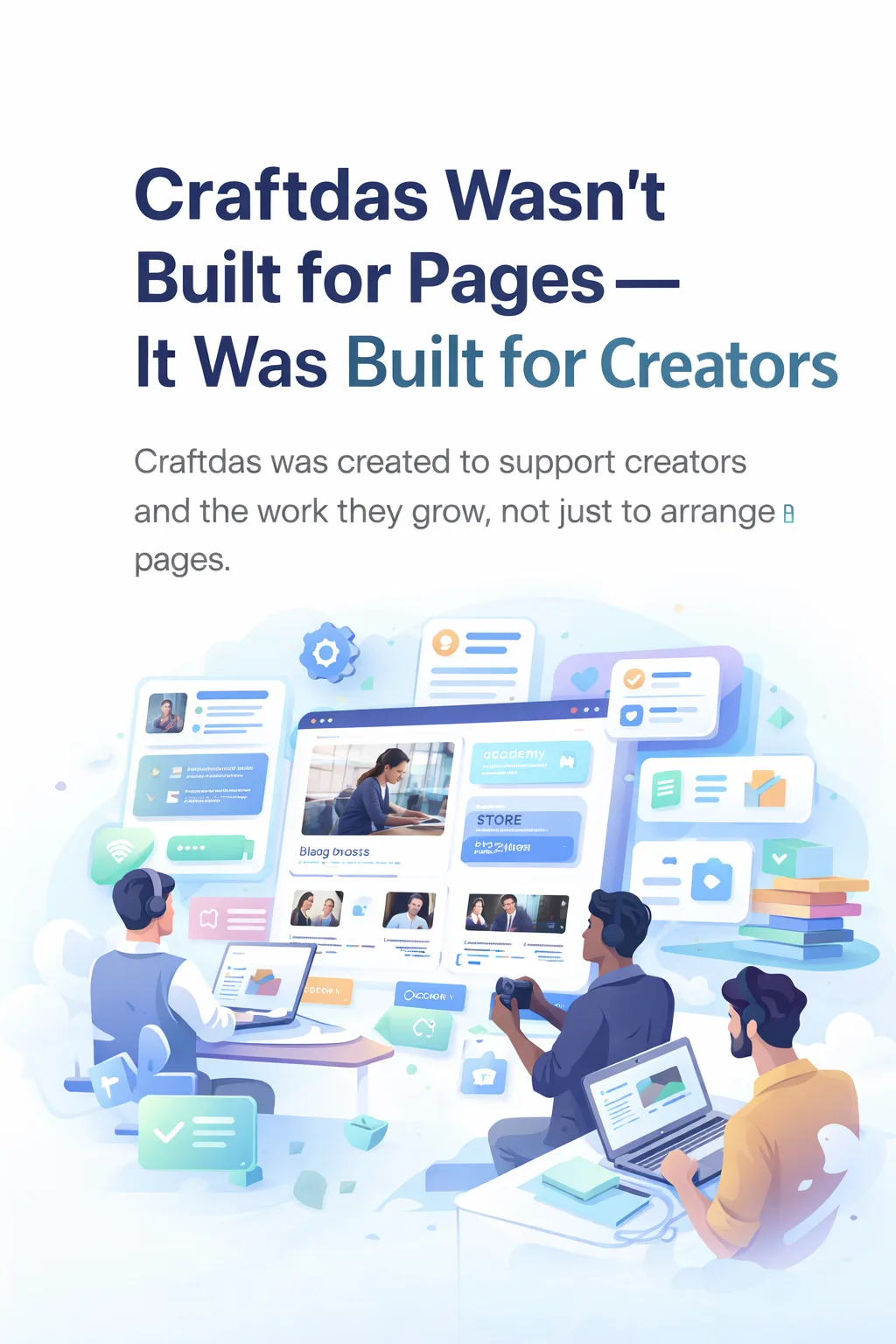

Craftdas wasn’t built for pages.
It was built for creators.
That statement may sound simple, but it represents a deep shift in how digital platforms should be designed—and why so many creators feel limited, frustrated, or boxed in by the tools they currently use.
Most platforms on the internet today are page-centric. They revolve around layouts, templates, sections, and visual arrangement. Pages become the main unit of value. Once a page looks good and is published, the platform considers its job done. But creators don’t think in pages. They think in ideas, stories, lessons, products, and growth. And that mismatch is where most platforms fail.
Craftdas exists to close that gap.
Creators Are Not Page Assemblers
A writer does not wake up thinking about sections and margins.
A teacher does not plan knowledge in terms of landing pages.
A photographer does not express vision through templates.
Creators think in meaning.
They think about what they want to say, what they want to teach, what they want to show, and how that work should grow over time. Pages are just containers—necessary, but secondary. When platforms prioritize pages over people, creators are forced to adapt their thinking to tools that were never designed for creative depth.
Craftdas flips that relationship.
Instead of asking creators to fit their work into pages, Craftdas adapts pages to fit the creator’s work.
The Problem With Page-First Platforms
Page-first platforms optimize for speed and appearance. They want creators to publish quickly, choose a theme, and move on. This works well for short-term goals: launching a site, announcing a service, or creating a temporary presence.
But long-term creators quickly run into problems:
Content becomes fragmented
Ideas lose connection
Growth requires rebuilding
Expansion feels risky
Quality becomes inconsistent
A blog starts to feel shallow.
A course feels disconnected from the rest of the platform.
A portfolio cannot evolve without breaking structure.
This happens because pages are static, but creators are not.
Craftdas was built to support motion, not stagnation.
Creation Is Ongoing, Not Finished
One of the biggest misconceptions in digital creation is that publishing equals completion. In reality, publishing is often just the beginning. Content improves through iteration. Ideas mature through context. Knowledge grows through connection.
Craftdas treats creation as an ongoing process.
Content on Craftdas is designed to be revisited, refined, expanded, and connected. Nothing is considered final simply because it has been published. The platform encourages creators to think beyond “done” and toward “developing.”
This mindset changes everything—from how content is structured to how it is discovered and reused.
Built Around Creators, Not Use Cases
Many platforms are built around narrow use cases: blogging, portfolios, landing pages, or online courses. Creators who fit neatly into those categories are served well—until they grow beyond them.
But real creators don’t stay in one lane.
A writer may become an educator.
A photographer may start mentoring.
A designer may launch products.
A creator may build a brand, not just content.
Craftdas is built around creators as evolving individuals, not fixed use cases. It does not force you to choose who you are upfront. Instead, it gives you a foundation that can support who you are becoming.
Structure Without Rigidity
One fear creators often have about structured platforms is loss of freedom. Too many rules. Too many constraints. Too much control.
Craftdas avoids this by separating structure from rigidity.
Structure exists to support clarity and growth. Rigidity exists to control outcomes. Craftdas embraces the former and rejects the latter.
Creators are guided by clear laws that promote quality, consistency, and scalability—but they are never boxed into one way of thinking or creating. The platform provides guardrails, not cages.
Why Craftdas Uses Systems Instead of Templates
Templates assume the future is predictable. They lock creators into decisions made too early, based on assumptions that rarely hold as work evolves.
Craftdas replaces templates with systems.
Systems adapt.
Systems scale.
Systems grow without collapsing.
Instead of asking “Which template do you want?” Craftdas asks “What are you building?” The answer to that question can change over time, and the platform is designed to change with it.
Content as an Asset, Not Decoration
On many platforms, content exists to fill space. Text is there to explain visuals. Images are there to make pages attractive. Once attention is captured, the content’s job is considered done.
Craftdas treats content differently.
Content is an asset.
It carries meaning, context, and long-term value. It can be reused, referenced, expanded, and connected. It is not disposable. When content is treated as infrastructure rather than decoration, creators are encouraged to invest more deeply in their work—and audiences feel the difference.
Quality Is a Responsibility
Craftdas does not believe quality should be optional.
Many platforms lower standards to attract more users. Craftdas raises standards to empower serious creators. It does this through laws—not vague tips, not optional suggestions.
These laws are not there to restrict creativity. They exist to protect it. When creators are supported by strong standards, they make better decisions naturally. Structure becomes a teacher, not a barrier.
Growth Without Fragmentation
One of the most painful experiences for creators is outgrowing their platform. What starts as a simple blog eventually needs features it was never designed to support. Creators are then forced to migrate, rebuild, or split their work across multiple tools.
Craftdas was designed to prevent this.
A creator can start with a single article and grow into a full ecosystem—without leaving the platform. Blogs can evolve into academies. Knowledge can become structured programs. Creative work can turn into sustainable systems.
Growth should feel like expansion, not escape.
Platform-Sufficient by Philosophy
Craftdas does not build dependency into its core. It does not force creators to rely on external algorithms, third-party tools, or trends they cannot control.
Instead, it encourages internal strength:
Clear content structure
Meaningful internal connections
Long-term discoverability
Direct value to audiences
External platforms can complement Craftdas—but they do not define it. The creator remains in control.
Respecting the Creator’s Intelligence
Craftdas assumes creators are capable of depth.
It does not treat them as users who need shortcuts or gimmicks. It treats them as builders of ideas. The platform rewards intentional work, thoughtful structure, and long-term thinking.
This approach may feel demanding at first—but it is also empowering. Creators who want to grow seriously finally have a platform that meets them at their level.
Pages Still Matter—But They Are Not the Point
Craftdas does not reject pages. Pages are necessary. They provide context and presentation. But they are not the foundation.
Creators are the foundation.
Pages serve creators—not the other way around.
When this relationship is reversed, platforms begin to feel alive instead of static. Content feels connected instead of scattered. Growth feels natural instead of forced.
Why This Difference Matters
Calling Craftdas “a page builder” or “a website tool” misses the essence of what it is trying to do. Craftdas is not competing on speed, templates, or visual tricks. It is competing on depth, structure, and longevity.
It is for creators who care about what they build.
For those who see their work as something worth doing properly.
For those who want their ideas to grow without losing meaning.
Built for the Long Term
Craftdas is not chasing trends. It is not optimized for quick wins or short-term hype. It is built for the long term—for creators who plan to still care about their work years from now.
It offers something rare in the digital world: patience.
Patience for growth.
Patience for mastery.
Patience for meaningful creation.
In the End, It’s About People
At its core, Craftdas is not about pages, features, or technology.
It is about people.
People who write.
People who teach.
People who build.
People who create with intention.
Craftdas exists to give those people a home that respects their work, supports their growth, and refuses to reduce their creativity to layouts and templates.
That is why Craftdas wasn’t built for pages.
It was built for creators.Below is a ~2,000-word body content for the article titled:
Craftdas Wasn’t Built for Pages—It Was Built for Creators
This is written in a public, confident, creator-first tone, suitable for a flagship blog post on Craftdas.
Craftdas wasn’t built for pages.
It was built for creators.
That statement may sound simple, but it represents a deep shift in how digital platforms should be designed—and why so many creators feel limited, frustrated, or boxed in by the tools they currently use.
Most platforms on the internet today are page-centric. They revolve around layouts, templates, sections, and visual arrangement. Pages become the main unit of value. Once a page looks good and is published, the platform considers its job done. But creators don’t think in pages. They think in ideas, stories, lessons, products, and growth. And that mismatch is where most platforms fail.
Craftdas exists to close that gap.
Creators Are Not Page Assemblers
A writer does not wake up thinking about sections and margins.
A teacher does not plan knowledge in terms of landing pages.
A photographer does not express vision through templates.
Creators think in meaning.
They think about what they want to say, what they want to teach, what they want to show, and how that work should grow over time. Pages are just containers—necessary, but secondary. When platforms prioritize pages over people, creators are forced to adapt their thinking to tools that were never designed for creative depth.
Craftdas flips that relationship.
Instead of asking creators to fit their work into pages, Craftdas adapts pages to fit the creator’s work.
The Problem With Page-First Platforms
Page-first platforms optimize for speed and appearance. They want creators to publish quickly, choose a theme, and move on. This works well for short-term goals: launching a site, announcing a service, or creating a temporary presence.
But long-term creators quickly run into problems:
Content becomes fragmented
Ideas lose connection
Growth requires rebuilding
Expansion feels risky
Quality becomes inconsistent
A blog starts to feel shallow.
A course feels disconnected from the rest of the platform.
A portfolio cannot evolve without breaking structure.
This happens because pages are static, but creators are not.
Craftdas was built to support motion, not stagnation.
Creation Is Ongoing, Not Finished
One of the biggest misconceptions in digital creation is that publishing equals completion. In reality, publishing is often just the beginning. Content improves through iteration. Ideas mature through context. Knowledge grows through connection.
Craftdas treats creation as an ongoing process.
Content on Craftdas is designed to be revisited, refined, expanded, and connected. Nothing is considered final simply because it has been published. The platform encourages creators to think beyond “done” and toward “developing.”
This mindset changes everything—from how content is structured to how it is discovered and reused.
Built Around Creators, Not Use Cases
Many platforms are built around narrow use cases: blogging, portfolios, landing pages, or online courses. Creators who fit neatly into those categories are served well—until they grow beyond them.
But real creators don’t stay in one lane.
A writer may become an educator.
A photographer may start mentoring.
A designer may launch products.
A creator may build a brand, not just content.
Craftdas is built around creators as evolving individuals, not fixed use cases. It does not force you to choose who you are upfront. Instead, it gives you a foundation that can support who you are becoming.
Structure Without Rigidity
One fear creators often have about structured platforms is loss of freedom. Too many rules. Too many constraints. Too much control.
Craftdas avoids this by separating structure from rigidity.
Structure exists to support clarity and growth. Rigidity exists to control outcomes. Craftdas embraces the former and rejects the latter.
Creators are guided by clear laws that promote quality, consistency, and scalability—but they are never boxed into one way of thinking or creating. The platform provides guardrails, not cages.
Why Craftdas Uses Systems Instead of Templates
Templates assume the future is predictable. They lock creators into decisions made too early, based on assumptions that rarely hold as work evolves.
Craftdas replaces templates with systems.
Systems adapt.
Systems scale.
Systems grow without collapsing.
Instead of asking “Which template do you want?” Craftdas asks “What are you building?” The answer to that question can change over time, and the platform is designed to change with it.
Content as an Asset, Not Decoration
On many platforms, content exists to fill space. Text is there to explain visuals. Images are there to make pages attractive. Once attention is captured, the content’s job is considered done.
Craftdas treats content differently.
Content is an asset.
It carries meaning, context, and long-term value. It can be reused, referenced, expanded, and connected. It is not disposable. When content is treated as infrastructure rather than decoration, creators are encouraged to invest more deeply in their work—and audiences feel the difference.
Quality Is a Responsibility
Craftdas does not believe quality should be optional.
Many platforms lower standards to attract more users. Craftdas raises standards to empower serious creators. It does this through laws—not vague tips, not optional suggestions.
These laws are not there to restrict creativity. They exist to protect it. When creators are supported by strong standards, they make better decisions naturally. Structure becomes a teacher, not a barrier.
Growth Without Fragmentation
One of the most painful experiences for creators is outgrowing their platform. What starts as a simple blog eventually needs features it was never designed to support. Creators are then forced to migrate, rebuild, or split their work across multiple tools.
Craftdas was designed to prevent this.
A creator can start with a single article and grow into a full ecosystem—without leaving the platform. Blogs can evolve into academies. Knowledge can become structured programs. Creative work can turn into sustainable systems.
Growth should feel like expansion, not escape.
Platform-Sufficient by Philosophy
Craftdas does not build dependency into its core. It does not force creators to rely on external algorithms, third-party tools, or trends they cannot control.
Instead, it encourages internal strength:
Clear content structure
Meaningful internal connections
Long-term discoverability
Direct value to audiences
External platforms can complement Craftdas—but they do not define it. The creator remains in control.
Respecting the Creator’s Intelligence
Craftdas assumes creators are capable of depth.
It does not treat them as users who need shortcuts or gimmicks. It treats them as builders of ideas. The platform rewards intentional work, thoughtful structure, and long-term thinking.
This approach may feel demanding at first—but it is also empowering. Creators who want to grow seriously finally have a platform that meets them at their level.
Pages Still Matter—But They Are Not the Point
Craftdas does not reject pages. Pages are necessary. They provide context and presentation. But they are not the foundation.
Creators are the foundation.
Pages serve creators—not the other way around.
When this relationship is reversed, platforms begin to feel alive instead of static. Content feels connected instead of scattered. Growth feels natural instead of forced.
Why This Difference Matters
Calling Craftdas “a page builder” or “a website tool” misses the essence of what it is trying to do. Craftdas is not competing on speed, templates, or visual tricks. It is competing on depth, structure, and longevity.
It is for creators who care about what they build.
For those who see their work as something worth doing properly.
For those who want their ideas to grow without losing meaning.
Built for the Long Term
Craftdas is not chasing trends. It is not optimized for quick wins or short-term hype. It is built for the long term—for creators who plan to still care about their work years from now.
It offers something rare in the digital world: patience.
Patience for growth.
Patience for mastery.
Patience for meaningful creation.
In the End, It’s About People
At its core, Craftdas is not about pages, features, or technology.
It is about people.
People who write.
People who teach.
People who build.
People who create with intention.
Craftdas exists to give those people a home that respects their work, supports their growth, and refuses to reduce their creativity to layouts and templates.
That is why Craftdas wasn’t built for pages.
It was built for creators.