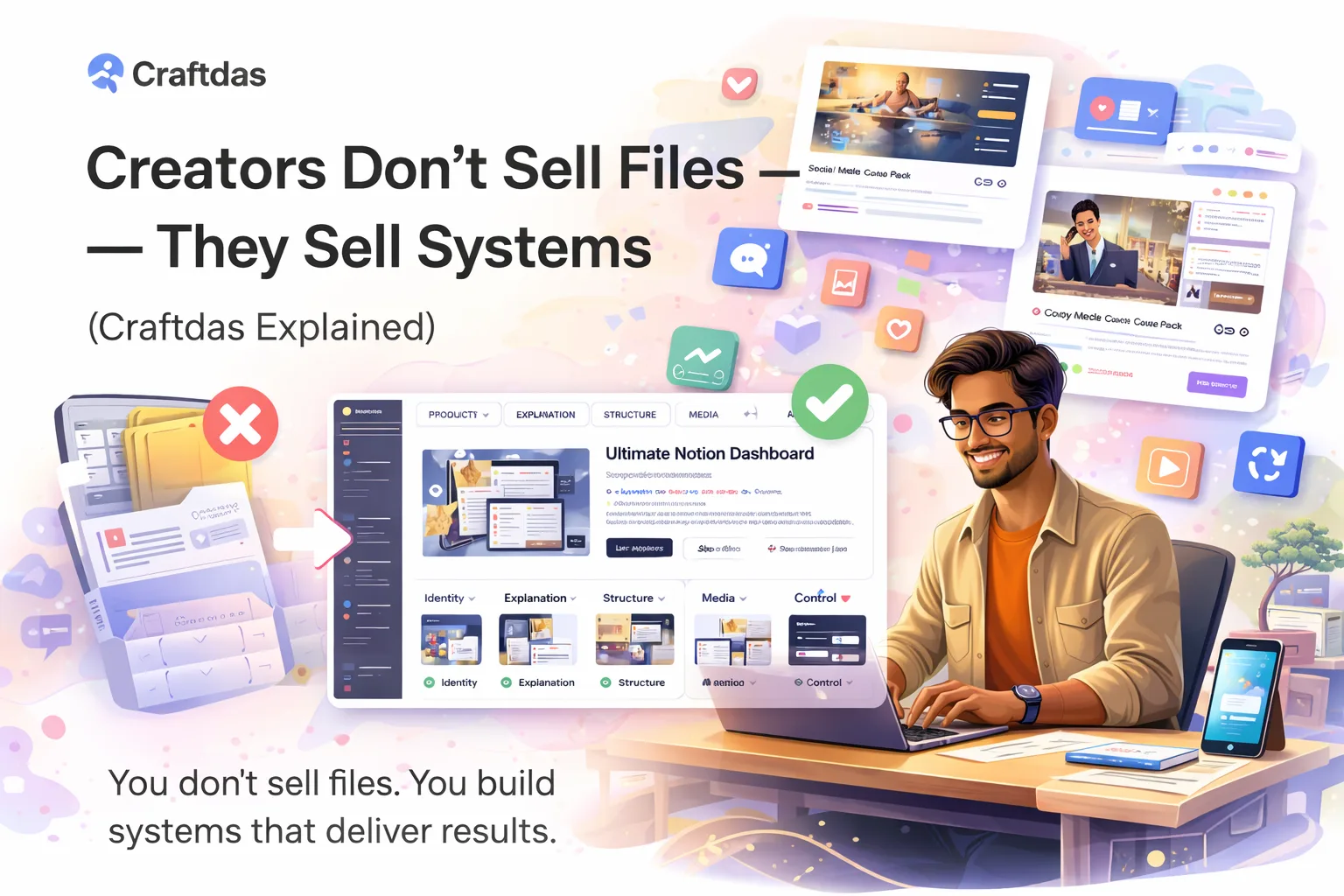

For years, creators have been told the same story:
Create something. Package it. Upload it. Sell it.
A PDF becomes a product.
A template becomes a product.
A video becomes a product.
But this thinking is incomplete — and it’s the reason many creators struggle to earn consistently, even when their work is genuinely valuable.
The truth is simple:
Creators don’t sell files.
They sell systems.
Files are only the surface.
Systems are the value underneath.
And until creators understand this difference, monetization will always feel fragile, exhausting, and unpredictable.
The Illusion of “Selling Files”
At first, selling files feels logical.
You make a design.
You export it.
You upload it.
You set a price.
Money comes in — sometimes.
But over time, cracks begin to show.
Buyers ask questions you thought the file already answered.
They struggle to apply what they bought.
They ask for updates, explanations, examples, or context.
Suddenly, the file alone isn’t enough.
That’s because the buyer was never paying for the file itself.
They were paying for what the file represents.
Knowledge
Structure
Process
Outcome
The file was just the container.
What People Actually Buy From Creators
When someone buys from a creator, they are not thinking:
“I want a ZIP file.”
They are thinking:
“I want a faster way to do this.”
“I want clarity.”
“I want a proven approach.”
“I want results without trial and error.”
The file is only the delivery format.
The system is what creates confidence.
A Notion template isn’t valuable because it exists.
It’s valuable because it organizes thinking.
A design pack isn’t valuable because of the assets.
It’s valuable because it speeds up creative work.
A course isn’t valuable because of the videos.
It’s valuable because it walks someone from confusion to competence.
Creators sell systems of thinking and execution — not downloads.
Why Most Creator Platforms Get This Wrong
Most platforms are built around the idea of uploads.
They ask:
What file are you selling?
Where is it hosted?
How do we deliver it?
They don’t ask:
How does this product work?
What problem does it solve?
How does it evolve?
How does it connect to your content?
As a result, creators are forced into a shallow product model:
Upload
Price
Promote
Repeat
This works for quick wins, but it breaks down when creators try to scale, update, or build a real catalog.
That’s why many creators feel stuck rebuilding from scratch every time they launch something new.
The System Mindset: The Real Shift
Once creators understand that they sell systems, everything changes.
They stop asking:
“What file should I sell next?”
And start asking:
“What system do people keep asking me for?”
“What process do I repeat over and over?”
“What thinking framework do I already use?”
This shift unlocks long-term value.
A system:
Can be explained
Can be demonstrated
Can be improved
Can be expanded
Can support multiple products
A file cannot do that on its own.
What a Creator System Actually Looks Like
A creator system usually includes:
Identity
What the product is, who it’s for, and where it fits.Context
Why it exists and what problem it solves.Structure
How the parts work together.Examples or Proof
Demonstrations, previews, or real usage.Guidance
How to apply it correctly.Evolution
Room for updates, improvements, or extensions.
Notice something important:
None of this depends on a specific file format.
The file is replaceable.
The system is not.
Why Files Fail Without Systems
When creators sell files without systems, a few things always happen:
Support Overload
Buyers keep asking questions because the system wasn’t clear.Low Retention
People buy once but don’t come back.No Scalability
Every new product feels like starting over.Pricing Pressure
Without perceived system value, creators compete on price.Burnout
Creators spend more time explaining than creating.
This is not a skill problem.
It’s a structure problem.
Systems Create Trust Before the Sale
Buyers trust systems more than files.
Why?
Because systems show intention.
When someone sees:
Clear product structure
Thoughtful explanation
Visual previews
Connected content
They feel safe buying.
They’re not guessing.
They’re not hoping.
They understand what they’re getting and how it works.
This trust is what separates serious creator businesses from side hustles.
How Craftdas Thinks About Products Differently
Craftdas was built around one core insight:
If creators sell systems, then products must be structured as systems — not uploads.
On Craftdas, a product is not just a downloadable item.
It is a living, structured entity.
Every product is designed to carry:
Identity
Context
Visual clarity
Explanation
Control
Growth potential
This removes the need for creators to duct-tape tools together.
Instead of asking, “Where do I host this?”
Creators ask, “How do I structure this system properly?”
That shift changes everything.
Products as Living Assets, Not Static Files
One of the biggest advantages of system-based products is longevity.
A static file:
Becomes outdated
Loses relevance
Requires replacement
A system-based product:
Evolves
Improves
Gains value over time
Creators can:
Update explanations
Add examples
Refine positioning
Improve clarity
All without rebuilding from scratch.
This turns products into assets, not one-time experiments.
How Systems Connect to Content
Systems don’t live in isolation.
They thrive when connected to content.
Articles explain the problem.
Products deliver the solution.
Tutorials build trust.
Systems turn trust into outcomes.
When products and content are connected intentionally, growth compounds.
Creators stop chasing attention and start building ecosystems.
Why Scaling Fails Without Systems
Most creators think scaling means:
More marketing
More posts
More promotion
In reality, scaling fails when systems are weak.
Without systems:
Updates become painful
Catalogs become messy
Branding becomes inconsistent
Management becomes chaotic
With systems:
New products follow the same structure
Old products improve over time
Everything feels organized
Scaling becomes calm, not chaotic.
Pricing Power Comes From Systems
Files are easy to compare.
Systems are not.
When creators sell files, buyers ask:
“Why is this more expensive than that one?”
When creators sell systems, buyers ask:
“Will this actually help me?”
Systems shift the conversation from price to value.
That’s where sustainable income lives.
The Creator Economy Is Maturing
Early creator monetization rewarded speed and novelty.
Today, buyers are more experienced.
They’ve bought bad products.
They’ve been disappointed before.
Now they look for:
Clarity
Structure
Proof
Longevity
Creators who still sell isolated files will struggle.
Creators who sell systems will win.
From Hustle to Infrastructure
Selling files is hustle-based.
Selling systems is infrastructure-based.
Hustle requires constant energy.
Infrastructure compounds.
Creators who build systems:
Reuse thinking
Reuse structure
Reuse workflows
They create once and refine many times.
This is how creator businesses survive long-term.
Why This Mindset Changes Everything
Once creators internalize that they sell systems, they:
Stop underpricing
Stop rebuilding
Stop chasing every trend
Stop feeling scattered
They focus on:
Structure
Clarity
Improvement
Longevity
This doesn’t make creativity rigid.
It makes it sustainable.
Final Thoughts: Files Deliver. Systems Transform.
Files are replaceable.
Systems are not.
Creators who understand this don’t just sell products — they build value engines.
They create things that:
Make sense
Solve real problems
Grow over time
Support their business
Craftdas exists to support this way of thinking — not by adding more tools, but by giving creators a system that matches how they actually create and sell.
Because in the end, creators don’t sell files.
They sell systems.
And systems are what last.