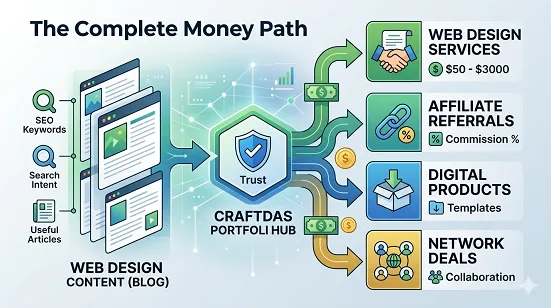

The Complete Income Architecture: Transforming a Web Design Blog into a Client and Affiliate Engine on Craftdas
Most web design bloggers struggle to monetize because they operate as artists writing for other artists. They publish articles about complex CSS variables, the history of typography, or abstract color theory. While technically impressive, this content attracts peers, not paying clients. To build a sustainable, high-revenue ecosystem, you must pivot from being a pure designer to operating as a digital strategist who solves expensive problems for businesses.
This blueprint dissects the exact mechanics of building a search-optimized content engine. It outlines how to capture high-intent traffic, build immediate authority using a centralized portfolio, and stack multiple revenue streams—from passive affiliate income to high-ticket consulting—without relying on unpredictable social media algorithms.
Phase 1: Strategic Niche Positioning and Buyer Psychology
To stand out in a crowded market, your blog must speak directly to a specific audience experiencing a specific pain point. You are not writing for senior developers; you are writing for the High-Intent Beginner and the Overwhelmed Business Owner.
The Target Audience Personas
The Local Service Business Owner (e.g., Plumbers, Dentists, Roofers): They do not care about frontend frameworks. They care that their phone is not ringing because their current website looks like it was built in 1998. They need trust signals, clear contact forms, and local SEO.
The Emerging Digital Creator: They have an audience on social media but lack a professional home base. They need to understand how a centralized portfolio controls their brand narrative better than a rented social feed.
The Freelance Novice: They have the technical skills to build things but lack the business acumen to position themselves, package their services, and attract their first paying clients.
Mapping the Problem-Solution Matrix
Every piece of content you produce must map directly to a commercial problem. If a post does not solve a problem that eventually leads to a transaction, it is a vanity metric.
| Client Problem | Emotional State | Your Content Solution | The Ultimate Goal |
| Website gets zero traffic | Frustrated, wasting money | "Why Your Competitors Rank Higher on Google (And How to Fix It)" | Sell an SEO site audit |
| Looks unprofessional | Insecure, losing trust | "The 5 Trust Elements Every Small Business Homepage Needs" | Sell a homepage redesign |
| Confused by tech | Overwhelmed, paralyzed | "How to Launch a Professional Portfolio Without Touching Code" | Drive a Craftdas affiliate signup |
| Low conversion rates | Anxious, leaking revenue | "Why Your Contact Form is Costing You Clients" | Sell a landing page optimization |
Establishing Visual Authority Immediately
Before you publish a single word, your own presentation must be flawless. When a reader clicks from your blog to your portfolio, the visual standard must instantly justify premium pricing. Utilize edge-to-edge, full-bleed layouts, entirely avoiding outdated white space margins or clunky borders. Treat your digital space like a premium 3D editorial lifestyle magazine. High-end, glossy visual standards subconsciously signal high-end capability, making the transition from "free blog reader" to "paying client" frictionless.
Phase 2: Search Ranking Content and SEO Architecture
Search intent is the foundation of digital income. If you answer the specific questions people type into search engines when they have their credit cards in hand, you bypass the need to "go viral."
Implementing a Universal Content Framework
To rank consistently, every post must follow a strict, logical architecture. Search engines reward predictability and comprehensive structuring. Adopt a universal blog structure for every article you write. This means establishing a rigid hierarchy:
The Direct Answer Hook (First 50 Words): Google prioritizes immediate answers. If the search is "how many pages does a small business website need?", your first sentence should be: "A standard small business website needs five essential pages: Home, About, Services, Testimonials, and Contact."
Semantic Subheadings (H2s and H3s): Break down the answer into actionable components. Use keyword-rich questions for your H2s.
Visual Evidence: Embed before-and-after screenshots of websites you have audited or redesigned.
The Actionable Checklist: Summarize the post at the bottom so readers can implement the advice immediately.
High-Intent Keyword Clusters
Stop trying to rank for single, highly competitive words like "web design." Focus on long-tail, low-competition queries where the user is actively seeking a solution.
Commercial Intent (Ready to Buy):
web design packages for local contractorscost to redesign a Shopify homepagehire someone to build creator portfolio
Navigational Intent (Looking for Tools):
best platform for freelance portfolios 2026Craftdas portfolio examples for writershow to set up a digital storefront without WordPress
Informational Intent (Educational but leading to a sale):
why is my bounce rate so high on mobilewhat is a call to action buttonhow to write an about page for a consultant
The "Pillar and Cluster" Strategy
Organize your blog into content silos. Write one massive, definitive guide (The Pillar)—for example, "The Ultimate Guide to Web Design for Small Businesses." Then, write 10-15 smaller, highly specific articles (The Clusters) that link back to the Pillar.
Cluster 1: "How to Choose Brand Colors for a Bakery"
Cluster 2: "Why Plumbers Need Mobile-Responsive Websites"
Cluster 3: "Setting Up Google My Business for Local SEO"
Every cluster post links to the main pillar post, passing authority and signaling to search engines that your site is a comprehensive library on the subject.
Phase 3: The Craftdas Affiliate Ecosystem
Affiliate marketing in the web design space is often executed poorly, relying on aggressive banner ads and spammy pop-ups. The most effective way to drive affiliate revenue is through natural contextual integration. Your goal is to position Craftdas not as a product you are selling, but as the inevitable solution to the problem you just solved in your article.
The Psychology of the Affiliate Recommendation
Readers trust practitioners, not salespeople. When you demonstrate exactly how you use a tool to achieve a professional result, the affiliate click becomes a natural next step.
Poor Execution: "Click here to buy Craftdas, it is the best site builder!"
High-Converting Execution: "After trying to manage messy hosting panels and broken plugins for years, I moved my entire digital operation to Craftdas.com. It allows me to maintain a glossy, editorial-grade portfolio while managing my blog and client network in one place. If you want to replicate the exact layout I use for my services, you can set up your creator profile here."
The Core Affiliate Content Types
To maximize your passive income, dedicate 30% of your blog content directly to platform education.
The "Over-the-Shoulder" Tutorial:
Create highly detailed, step-by-step written guides (supplemented with screen recordings) showing exactly how to achieve a specific outcome.
Title Example: "How to Build a High-Converting Freelance Service Page in 45 Minutes."
The "Platform vs. Platform" Breakdown:
Users searching for comparisons are at the bottom of the funnel; they have their wallets out and are just deciding between two options. Write objective, feature-by-feature comparisons highlighting where the Craftdas network excels for creators and small businesses.
Title Example: "Why Creators Are Moving from Traditional Site Builders to Integrated Networks."
The "Business in a Box" Blueprint:
Show people how to start making money using the platform.
Title Example: "The Zero-Budget Guide to Selling Digital Downloads Online."
Strategic Link Placement
Do not bury your links at the bottom of a 2,000-word post. Use a three-strike placement strategy:
Top 10% of the article: A soft contextual link for readers who already know what they want.
Middle of the article: Placed inside a tutorial or immediately after explaining a complex problem that the platform solves.
The Conclusion: A firm Call to Action (CTA) summarizing the benefits of taking action today.
Phase 4: Stacking the Revenue Pyramid
Relying solely on one income stream is a critical vulnerability. A properly structured web design blog acts as a funnel that captures different types of buyers at different price points.
Tier 1: Digital Products (Low-Barrier, Highly Scalable)
Not every reader is ready to drop thousands of dollars on a custom website build. Capture the segment of your audience that has more time than money by offering digital assets.
The Website Audit Checklist ($19): A comprehensive 50-point checklist for small businesses to evaluate their own sites.
The Client Onboarding Questionnaire ($29): For other freelance designers reading your blog, sell the exact templates you use to extract information from clients.
Wireframe Component Kits ($49): Sell pre-designed, structural layouts that beginners can trace or use as blueprints.
Tier 2: Productized Services (Mid-Ticket, Highly Efficient)
Custom web design requires proposals, discovery calls, and scope creep. Productized services have fixed prices, fixed scopes, and fixed delivery times. You sell them directly from your blog like items on a shelf.
The Tear-Down Video Audit ($150): The client sends their URL. You record a 15-minute screen-share video breaking down why their site is losing money and exactly what to change. No revisions, delivered in 48 hours.
The "Link-in-Bio" Transformation ($250): You upgrade a creator's messy social media link tree into a fully branded, high-converting mobile landing page on Craftdas.
The Speed Optimization Package ($300): A purely technical service where you clean up their image sizes, minify code, and improve their Google PageSpeed Insights score.
Tier 3: Custom Client Builds (High-Ticket, Deep Strategy)
This is where your blog proves its ultimate worth. When a local business owner reads your post detailing exactly why their current site is failing, you become the undisputed expert in their eyes. You are no longer competing on price on freelance bidding sites; you are the consultant they sought out.
Offer full, bespoke website builds starting at $2,500+.
Offer ongoing monthly retainers ($300/month) for SEO content updates, hosting maintenance, and analytics reporting.
Tier 4: The Network Effect Pipeline
Do not treat the platform hosting your portfolio as just software; treat it as a room full of potential clients. The Craftdas ecosystem is populated by other creators, writers, and digital entrepreneurs.
Identify high-performing writers or creators with visually poor profiles.
Send a direct, value-first message: "Your content on digital marketing is exceptional, but your current landing page layout is causing friction for mobile users. I mapped out a structural fix for your header. Let me know if you'd like to see it."
Use your blog as your resume. When they ask for your credentials, send them a link to your most comprehensive article on conversion optimization.
Phase 5: The Essential Skill Acquisition Protocol
To execute this strategy, raw design talent is insufficient. You must build a specific stack of interdisciplinary skills to drive traffic and convert it into revenue.
1. Conversion Copywriting
Beautiful design cannot save confusing text. You must master the art of writing copy that compels action.
The PAS Formula (Problem, Agitation, Solution): Every sales page and blog introduction should follow this logic. Identify the exact problem the reader has. Agitate it by explaining what it is costing them (time, money, reputation). Present your service or affiliate link as the definitive solution.
Benefit-Driven Headlines: Stop using functional headings like "My Services." Use outcome-driven headings like "Turn Your Casual Website Visitors into Booked Appointments."
2. Technical SEO Mastery
Writing good content is only half the battle; search engines must be able to parse and understand it.
Image Optimization: Every image must be compressed to load instantly. Alt-text must be descriptive and include secondary keywords (e.g., instead of
img45.jpg, useplumbing-website-homepage-design-example.jpg).Internal Linking Architecture: Never leave a blog post orphaned. Every article must link to at least three other relevant articles on your site to keep readers circulating in your ecosystem.
Rich Snippets and Schema: Understand how to structure your HTML so that Google can easily pull your reviews, FAQs, and pricing directly into the search results.
3. Client Psychology and Objection Handling
When a reader reaches out for a service, you must know how to close the deal without sounding desperate.
Value-Based Pricing: Never charge by the hour. An hour of your time means nothing to a client. Charge based on the value you are providing. If your website redesign will help a contractor book three extra $5,000 jobs this year, your design is not worth $500; it is worth $3,000.
The Pre-emptive FAQ: Build a robust FAQ section on your service pages that addresses every single reason a client might say no (cost, timeline, platform lock-in) before they even get on a call with you.
Phase 6: The 90-Day Execution Blueprint
Theory without a strict execution schedule is useless. Follow this sequential timeline to launch your revenue engine.
Days 1-15: The Foundation and Facade
Action 1: Secure your domain and establish your portfolio. Ensure the visual aesthetic is flawless—focus on high-contrast, edge-to-edge structural layouts.
Action 2: Create your core static pages: A highly persuasive "About" page detailing your philosophy, a clear "Services" page with productized tiers, and a seamless "Contact" funnel.
Action 3: Sign up for the required affiliate programs, secure your tracking links, and build a spreadsheet to manage your link placements.
Days 16-45: The Content Sprint
Action 1: Perform deep keyword research targeting 15 low-competition, high-intent queries specific to your target personas.
Action 2: Write and publish your "Pillar" article (3,000+ words).
Action 3: Write and publish 8 specific "Cluster" articles (1,000+ words each) that link directly back to the Pillar post. Ensure every post uses the rigid, universal structural framework.
Days 46-75: Productization and Outreach
Action 1: Extract the most common advice you gave in your first 9 articles and package it into a downloadable digital product (e.g., a PDF checklist or a wireframe template). Price it under $30.
Action 2: Launch your first productized service (e.g., The $150 Video Audit) and add the booking link to the navigation bar of your site.
Action 3: Begin engaging inside professional networks. Leave highly technical, valuable comments on other creators' posts to draw traffic back to your own optimized profile.
Days 76-90: Analytics and Refinement
Action 1: Connect Google Search Console. Analyze which search queries are generating impressions but failing to get clicks. Rewrite the title tags and meta descriptions for those specific posts to improve the click-through rate.
Action 2: Audit your affiliate link performance. If an article is getting traffic but no clicks, redesign the CTA module to make it more visually distinct within the article body.
Action 3: Publish 4 more cluster articles targeting the questions that actual users have submitted through your contact form.
By treating your web design blog not as a personal diary, but as a rigidly structured, search-optimized business engine, you transition from hunting for clients to building a system that attracts them to you automatically.