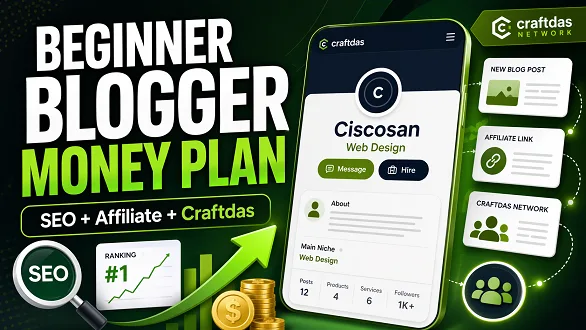

The High-Signal Architect: Turning a Web Design Blog into a Revenue-Generating Ecosystem
The divide between a struggling web design blogger and a high-earning digital strategist isn't technical skill; it is architecture. Most bloggers treat their site as a digital diary, focusing on aesthetics or coding trends that interest only their peers. To generate serious income, you must pivot. Your blog is no longer a collection of "posts"—it is a search-optimized funnel designed to capture intent, build authority via a centralized network, and convert traffic into multiple income streams.
This blueprint outlines a rigorous system to dominate the search landscape and the Craftdas ecosystem. By the end of this guide, you will have the structural logic required to build a money machine that compounds over time.
Phase 1: Strategic Intelligence and Market Positioning
Success begins with EEAT (Experience, Expertise, Authoritativeness, and Trustworthiness). You are not writing for everyone; you are writing for the High-Intent Beginner. These are small business owners, local service providers, and emerging creators who possess a budget but lack the technical vocabulary to execute their vision.
The Psychology of Search Intent
To rank, your content must satisfy specific levels of search intent. If you miss the intent, you miss the lead.
Informational (The "What"): Users are identifying a problem.
Query: "Why is my website loading slowly?"
Strategy: Provide a direct, data-backed answer. Position speed as a revenue-killer.
Commercial (The "Which"): Users are comparing solutions.
Query: "Best portfolio builders for creative freelancers."
Strategy: Use a comparison table. Highlight the integrated network benefits of Craftdas over siloed builders.
Transactional (The "Do"): Users are ready to hire or buy.
Query: "Hire a landing page designer for a small business."
Strategy: Direct them to your service page with a clear, frictionless CTA.
Mapping Your Content Silos
Organize your expertise into three distinct pillars to signal topical authority to AI search engines:
| Pillar | Focus | Commercial Outcome |
| Pillar 1: Performance Design | Speed, SEO, and Layout Structure. | Sells Site Audits and Technical Fixes. |
| Pillar 2: Brand Authority | Portfolio Trust, Glossy Visuals, and Credibility. | Drives Craftdas Affiliate Signups. |
| Pillar 3: Conversion Logic | Copywriting, CTAs, and User Journey. | Sells Landing Page and UX Consulting. |
Phase 2: Semantic Content Architecture (The UBS Method)
To rank for intent-based queries like “how to make money as a web design blogger,” your posts must follow a strict, logical hierarchy. AI search engines and human readers both prioritize scannability.
The Universal Blog Structure (UBS) Hierarchy
Every post must include these five structural components:
The Featured Snippet Hook: In the first 50 words, provide a direct answer to the primary keyword question.
Example: "To make money as a web design blogger, you must monetize through a combination of affiliate referrals, productized design services, and digital assets."
Semantic Subheadings (H2s & H3s): Use question-based headings. Instead of "SEO Tips," use "How Does SEO Affect Small Business Revenue?"
Evidence-Based Data Blocks: Use tables or bulleted lists to break up dense paragraphs.
Contextual Internal Links: Link to at least three other posts within the same content silo to pass "link juice."
The Recursive Conclusion: Summarize the key takeaways and provide one high-value action step.
Phase 3: The Craftdas Conversion Engine
Your blog is the top of the funnel (Traffic). Your Craftdas Portfolio is the middle of the funnel (Trust). The platform isn't just a place to host images; it is a live demonstration of your expertise.
Invisible Affiliate Integration
Hard-selling is an amateur move. High-signal bloggers use Contextual Integration.
The "Behind the Scenes" Technique: Write a post titled "How I Built My Professional Portfolio in Under 60 Minutes." Show screenshots of the Craftdas interface. Explain how it eliminates the headache of hosting and plugins.
The Solution-First Link: When discussing the need for a professional online presence, link to Craftdas as the specific tool that solves the problem of "looking amateur."
Building a "Trust Vault"
When a reader clicks from your blog to your portfolio, the transition should be seamless but elevated. Use editorial-grade, glossy visual standards. * Remove Clutter: No white margins, no clunky borders, and no distracting widgets.
3D Mockups: Showcase your work in premium lifestyle settings (laptops on clean desks, mobile views on high-end phones).
The Logic Gate: If a piece of work doesn't solve a client's problem, do not include it. Every portfolio piece should have a one-paragraph "Problem-Solution-Result" case study.
Phase 4: The 5-Layer Revenue Architecture
To scale, you must move away from the "trading time for money" trap. Implement a stacked income model where each layer supports the next.
1. Passive Revenue (Affiliate Commissions)
Target people who are exactly where you were six months ago.
Content Type: Step-by-step setup guides.
The Hook: "Don't build a website; build a network presence."
Formula: Focus on the long-term benefit of the Craftdas ecosystem—community, discovery, and integrated selling.
2. Scalable Revenue (Digital Products)
Once you've explained a concept 20 times on your blog, turn that explanation into a paid asset.
Idea 1: A "Small Business Homepage Checklist" (PDF).
Idea 2: A "Creative Director’s Wireframe Kit" (SVG/PNG).
Idea 3: An "SEO Audit Spreadsheet" for local businesses.
Pricing: Keep these in the "Impulse Buy" range ($10–$47).
3. Active Revenue (Productized Services)
Custom web design is hard to scale. Productized services are easy.
The Landing Page Audit ($150): A 10-minute video review of a client's current page.
The Craftdas Migration ($350): Moving a client from a clunky WordPress site to a streamlined Craftdas profile.
The Portfolio Refresh ($200): Selecting and retouching a creator's best work for maximum impact.
4. High-Ticket Revenue (Strategic Consulting)
This is for the client who wants you to handle everything.
Offer: A 3-month "Digital Presence Growth" retainer.
Components: Design updates, SEO-optimized blog content, and conversion tracking.
Price: $1,500+ per month.
5. Network Revenue (Craftdas Ecosystem Deals)
The Craftdas network is a goldmine of pre-qualified leads.
The Strategy: Engage with other creators. When you see a high-performing writer with a poorly structured profile, reach out. Offer a "Collaboration" where you redesign their service page in exchange for a fee or a cross-promotion.
Phase 5: Technical Mastery and "Moat" Construction
In a world of AI-generated content, your "moat" (competitive advantage) is your unique perspective and technical precision. You must master the skills that a machine cannot simulate.
High-Level Skill Stack
Psychological Copywriting: Understanding the "Why" behind the "Buy." Focus on the PAS Framework (Problem, Agitation, Solution). * Problem: Your website has no visitors.
Agitation: You are losing $2,000 in potential revenue every month.
Solution: My SEO-driven design strategy.
Conversion Rate Optimization (CRO): Learn where the eye travels on a page. Master the "F-Pattern" and the "Z-Pattern" for layout design.
Search Logic: Beyond just keywords, understand Entity-Based SEO. Search engines now look for how entities (you, web design, Craftdas, small business) relate to each other.
Phase 6: The Long-Term Velocity Plan (90-Day Sprint)
If you follow this timeline, you will have a functional income engine within three months.
Month 1: Foundation and Authority
Week 1: Optimize your Craftdas portfolio. Ensure every visual is high-gloss and editorial-grade.
Week 2: Identify 10 low-competition keywords (e.g., "how to design a landing page for a plumbing business").
Week 3: Write your "Pillar Post"—a 3,000-word definitive guide to web design for your target niche.
Week 4: Set up your first productized service (The Website Audit).
Month 2: Traffic and Lead Capture
Week 5-6: Write four "Cluster Posts" that link back to your Pillar Post.
Week 7: Create a "Lead Magnet" (e.g., a free website checklist) to capture email addresses.
Week 8: Launch your first digital product (e.g., a $15 wireframe template).
Month 3: Network Expansion and Scaling
Week 9-10: Actively message 5 creators a week on the Craftdas network to offer collaboration or audits.
Week 11: Write a "Comparison Post" (Craftdas vs. Competitors) to drive affiliate sales.
Week 12: Review your analytics. Identify which post is getting the most traffic and add a high-ticket service CTA to that specific page.
The Financial Logic Gate
To measure your success, use this fundamental formula:
Traffic: Driven by your SEO Blog.
Conversion Rate: Driven by the trust in your Craftdas Portfolio.
Average Order Value: Driven by your stacked services (Affiliates + Products + Consulting).
The "One Sentence" Mission
Stop blogging about what you like; start blogging about the solution your high-paying client is currently searching for.
Every post must serve a purpose: Rank, Refer, or Sell. If it does none of those, it is a hobby. If it does all three, it is a business.
By positioning yourself as the bridge between "technical confusion" and "professional clarity," you turn your blog into a high-signal asset that commands respect—and premium rates—in any market.
Which specific service or digital product do you want to build first to test this funnel?