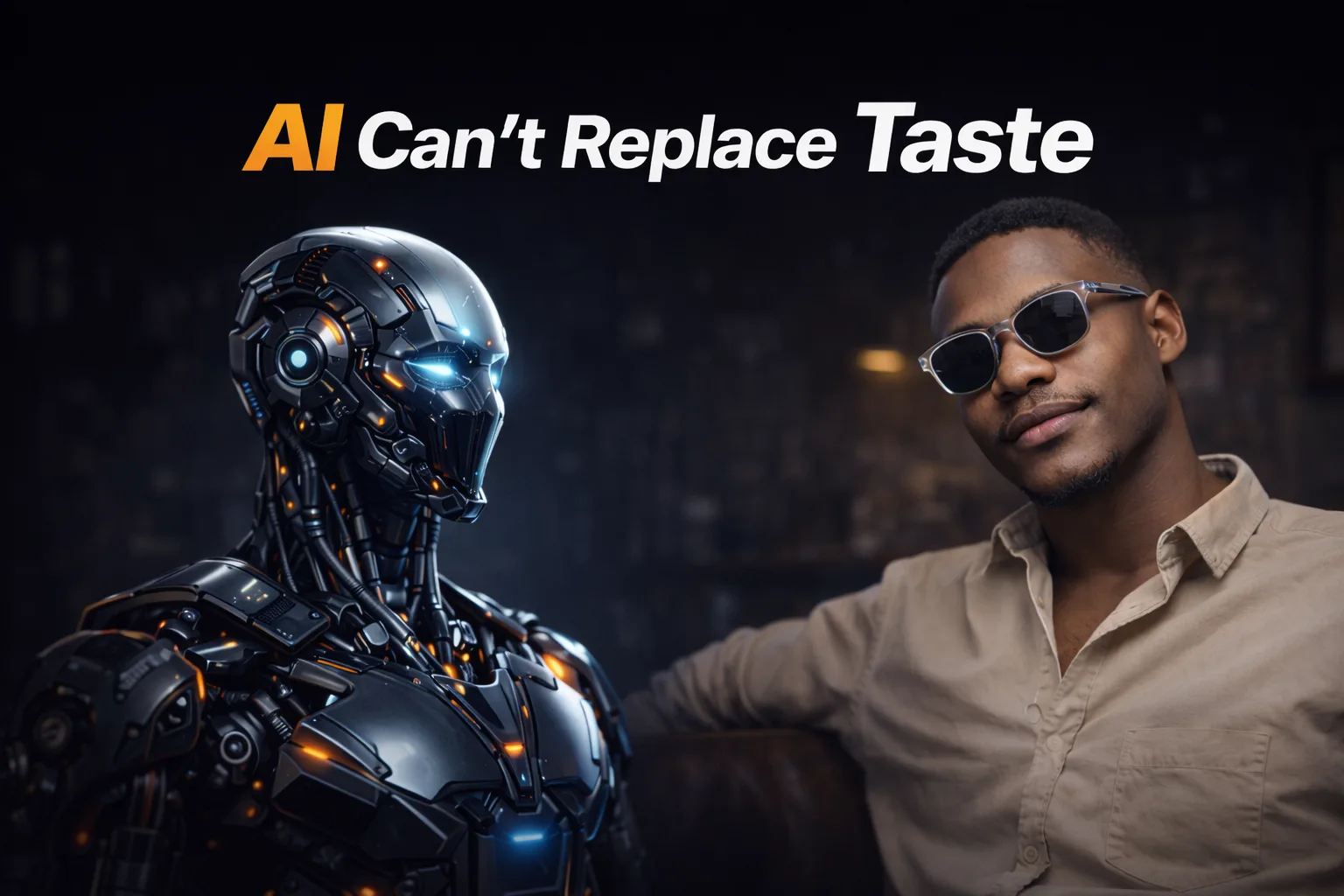

Why AI Cannot Replace a Smart 3D Artist
By the Team at Lightson Design Lab
For Craftdas
Let's skip the panic and get straight to the point. Yes, AI image generators can spit out a vaguely plausible product shot in six seconds. Yes, the tech is impressive in a "look what the algorithm did" sort of way. And yes, the social media feeds are flooded with glossy, dreamlike renders that have no author and no soul.
But here's the quiet truth that doesn't make it into the hype cycle: In a commercial studio with paying clients and real deadlines, AI is a fantastic intern and a terrible creative director.
At Lightson Design Lab, we've spent the last two years integrating AI tools into various parts of our workflow—not to replace our artists, but to see where the edges actually are. What we've learned is that the gap between "generating an image" and "delivering a solution" is vast. It is a gap filled entirely by human judgment, taste, and the kind of decision-making that a diffusion model simply cannot fake.
Here is the realistic, unemotional case for why the smart 3D artist isn't going anywhere.
The Difference Between an Image and an Answer
AI is incredible at interpolation. Give it a billion images tagged "modern living room," and it will give you back a statistically perfect modern living room. The couch will be the right shape. The light will fall in a pleasing way. The plants will be strategically placed.
But ask that same AI to solve a specific design problem and it falls apart.
A client doesn't walk into Lightson Design Lab and say, "Generate me a generic image of a bottle." They walk in with a brief that sounds like this: "We need to show how our new ergonomic handle is different from the old one, but we can't show the competitor's product, and we need to emphasize the thumb groove without making the grip look weak, and also the material needs to read as 'soft-touch rubber' but in a premium way, not a cheap way."
That paragraph is a stack of constraints, trade-offs, and communication goals. An AI can give you a bottle. It cannot give you that bottle. The smart 3D artist listens to that brief, filters it through years of understanding how light behaves on matte surfaces, and makes about fifty micro-decisions regarding focal length, bevel radius, and specular breakup. Those decisions are invisible in the final render, but they are the entire reason the client signs off on the first round.
Taste is Not a Dataset
We need to talk about taste. It's a word that makes some people uncomfortable in technical circles because it sounds subjective and fluffy. It is neither. Taste, in a commercial context, is the ability to recognize when something is right for a specific audience and a specific brand.
AI models are trained on the average of the internet. The average of the internet is, by definition, mediocre. It's the middle of the bell curve. It's the "good enough" image that gets a like and a scroll.
Smart 3D artists operate at the edges of that curve. We know when a reflection is too sharp and reads as "glassy" instead of "glossy." We know that the difference between a luxury watch render and a mall kiosk watch render is about three pixels of edge wear and a slight desaturation of the metal. AI doesn't know that because AI doesn't understand *why* Cartier looks different from Casio. It just knows they both have numbers and hands.
Taste is the human filter that says, "That looks like a stock photo. Delete it. Let's try it with a 50mm lens and move the key light 15 degrees off-axis." That's not magic. That's experience. And it's the part of the job that has no prompt equivalent.
Storytelling is Not Scene Generation
Here's a scenario that plays out in our studio regularly. A client wants a 3D visualization for a new co-working space. The brief says "warm, inviting, productive."
An AI prompt can generate a room with warm lighting, some wooden tables, and a few generic people staring at generic laptops. It will be technically correct. It will also be completely forgettable.
A smart 3D artist reads "warm, inviting, productive" and starts asking questions the client didn't know they needed to answer. Where is the power outlet relative to the seat? What's on the table that suggests someone just stepped away for a coffee? Is the light hitting the plant in a way that makes the space feel alive? Should we scatter some analog items—a notebook, a pen—to break up the digital coldness of the laptops?
These are narrative choices. They are the difference between a space that looks like a render and a space that looks like a place where you could actually get work done. AI is a scene generator. Artists are storytellers. One fills a frame. The other creates a world you believe in.
The Economics of Revision Hell
This is the part that gets glossed over in every "AI will replace artists" hot take. Commercial 3D work is not about the first image. It is about the tenth image.
Clients change their minds. They see something and realize it's not what they wanted. The logo is slightly off-center. The material needs to be 20% more matte. The hero product needs to rotate two degrees to the left.
With a purely AI-generated workflow, that feedback loop is a nightmare of re-prompting and crossing your fingers. You cannot tell Midjourney, "Keep everything exactly the same, but just rotate the object two degrees left." You have to roll the dice again and hope the algorithm spits out something close enough.
With a smart 3D artist working in Blender, Cinema 4D, or Maya, that revision is a matter of selecting an object, pressing R, typing -2, and hitting render. The scene file is a controllable, deterministic asset. The artist owns the pixels. They can make surgical adjustments that preserve all the work that came before. That is the difference between a professional service and a slot machine.
The Final Frame is a Business Decision
Let's zoom out. The reason a smart 3D artist cannot be replaced by AI is not because AI is bad. It's because the job of a 3D artist was never just about making pictures.
The job is about:
- Interpreting vague client language into visual form.
- Making hundreds of tiny, irreversible choices that add up to a coherent style.
- Building a scene file that can be revised, repurposed, and handed off to another artist.
- Understanding the technical constraints of the final output—whether it's a 4K video for a tradeshow booth or a compressed glTF file for a mobile web viewer.
AI is a tool. A powerful one. We use it at Lightson Design Lab for concept exploration, for generating texture variations, and for breaking through creative block. But the person driving the bus is still a person. The person making the call on whether a render is "client ready" is still a person.
The smart 3D artist isn't threatened by AI. The smart 3D artist is the one who knows *when* to use AI and, more importantly, when to ignore it completely and just model the damn thing by hand.
The future of 3D isn't about humans versus machines. It's about humans who know how to think versus humans who only know how to prompt. Be the one who thinks.