
1. Introduction
There was a time when creative professionals could focus entirely on their craft. Painters painted. Writers wrote. Musicians composed. The business of creativity understanding audiences, pricing work, building sustainable careers was secondary, often handled by agents, managers, or simply ignored in favor of artistic purity.
That era is over.
Today, every creative act generates data. Every post, every stream, every sale, every comment creates a trail of information. This data represents something invaluable: real feedback from real people about your creative work. And the creatives who learn to read this information have an undeniable advantage.
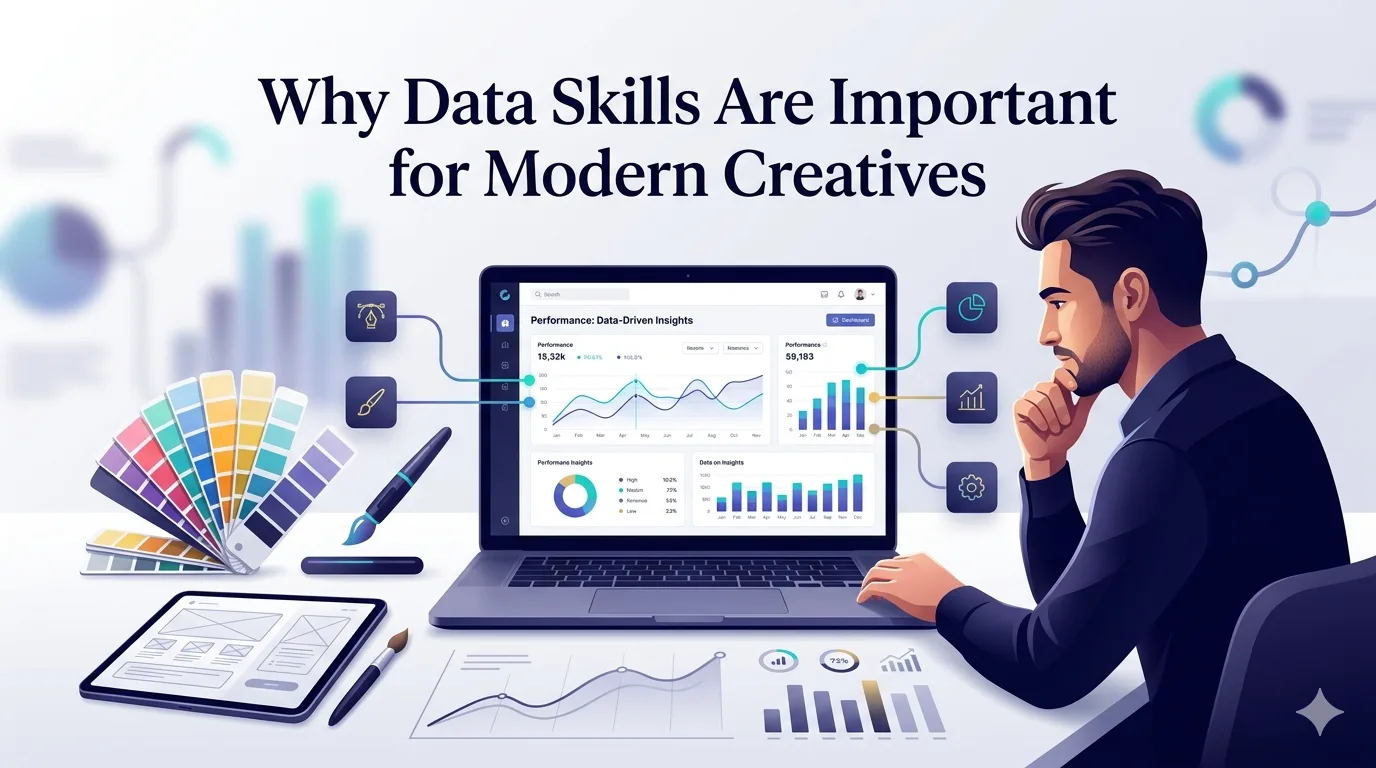
Data skills are no longer optional for modern creatives. They are as essential as understanding color theory, narrative structure, or musical composition. Not because data replaces creativity, but because data makes creativity more effective, more sustainable, and more impactful.
This article explores why data skills matter for today's creatives, what these skills actually look like in practice, and how developing them can transform your creative career without compromising your artistic vision.
2. The Changing Creative Landscape
The creative industries have transformed dramatically over the past decade. Understanding these changes makes the case for data skills clear.
From Gatekeepers to Direct Access
In the past, creatives depended on intermediaries gallery owners, publishers, record labels, agents to reach audiences. These gatekeepers controlled distribution and, consequently, information. Creatives rarely saw data about who was buying their work or why.
Today, platforms like Instagram, Spotify, Substack, and Etsy give creatives direct access to their audiences and direct access to data about those audiences. You can see who is looking at your work, where they live, what they engage with, and when they stop paying attention. This information was once available only to large organizations with research budgets. Now it's available to anyone.
From Scarcity to Abundance
The internet has created an explosion of creative content. Millions of songs, articles, images, and videos compete for attention. In this environment, understanding your audience isn't optional it's survival.
Creatives who guess about what their audience wants will be outperformed by creatives who know. Data skills help you navigate abundance by revealing where to focus your limited time and energy.
From Passion to Sustainability
Many creatives start their careers driven by passion alone. But passion doesn't pay bills. Building a sustainable creative career requires understanding what sells, who buys, and why.
Data skills help you answer practical questions: Which pieces should I create more of? When should I release my work? How should I price my products? Where should I focus my promotional efforts? Without data, these are guesses. With data, they're informed decisions.
3. What Data Skills Actually Mean for Creatives
Data skills sound technical and intimidating. But for creatives, they're simpler than you might think.
Data Literacy, Not Data Science
You don't need to become a programmer or statistician. You need basic data literacy: the ability to read, understand, and use information to make decisions.
This includes:
- Knowing where to find relevant data (platform analytics, sales records, feedback)
- Understanding what different metrics mean (reach vs. engagement, retention vs. conversion)
- Recognizing patterns over time (trends, seasonality, growth rates)
- Asking good questions of your data (not just "what happened" but "why did it happen")
- Making decisions based on evidence, not just intuition
The Core Data Skills for Creatives
Observation: The ability to notice what's happening in your data without jumping to conclusions. This means checking your analytics regularly and simply paying attention.
Pattern recognition: The ability to spot what keeps happening again and again. This is something creatives already do with color, composition, and narrative. You're just applying it to numbers.
Critical thinking: The ability to question your data. Is this trend real or a one-time spike? Does this number mean what I think it means? What else might explain this pattern?
Decision-making under uncertainty: The ability to act on incomplete information. Data rarely provides 100% certainty. Data skills help you make good decisions with the information you have.
Communication: The ability to explain what you've learned to others clients, collaborators, or your future self. This is storytelling with numbers.
4. How Data Skills Benefit Your Creative Practice
Let's move from abstract benefits to concrete advantages.
Better Decisions About What to Create
Instead of guessing what your audience wants, you can look at what they've already responded to. A writer who tracks which articles get the most engagement knows what topics to explore further. A musician who studies streaming data knows which songs to promote. A visual artist who tracks sales knows which pieces to create more of.
Data doesn't tell you what to create—you still make that choice. But it tells you where your audience is already showing up.
Smarter Use of Your Time and Energy
Creative work requires enormous time investment. Data helps you allocate that time wisely. If video content generates three times more engagement than written content, you might shift your focus. If posts published on weekend mornings reach twice as many people, you might change your schedule.
These small adjustments compound over time. The creative who uses data makes better use of their limited hours.
Deeper Connection with Your Audience
Understanding your audience isn't about manipulation. It's about service. When you know who your audience is, what they value, and how they behave, you can create work that genuinely serves them.
A ceramic artist who discovers that buyers are mostly young professionals in cities might create smaller, shippable pieces. A podcaster who learns that listeners listen during commutes might adjust episode length. These aren't compromises they're thoughtful responses to real needs.
Greater Career Resilience
Creatives with data skills adapt more quickly when things change. When a platform's algorithm shifts, they notice the impact in their data and adjust. When a new opportunity emerges, they can evaluate whether it's worth pursuing based on evidence.
Data skills also help you prove your value. A designer who can show that their work increased conversion rates by 25% has a much stronger case for higher rates than a designer who says "I think it looks better."
5. Common Fears About Data (And Why They're Wrong)
Many creatives resist data skills because of genuine fears. Let's address them directly.
"Data will make my work cold and calculated."
This is the most common fear—that using data will strip the soul from creative work. But data doesn't tell you what to create. It tells you how people respond to what you've already created. Your voice, your vision, your unique perspective—those remain yours. Data just helps you understand whether you're connecting.
The most emotionally resonant work often comes from creators who deeply understand their audience. Data helps build that understanding.
"I'm not a numbers person."
You don't need to be. The math involved in creative data work is basic counting, comparing, noticing which number is bigger. If you can calculate a tip, you have enough math skill. The real skills are observation, pattern recognition, and curiosity things you already use in your creative practice.
"I don't want to chase trends."
Using data doesn't mean abandoning your vision to chase what's popular. It means understanding how people respond to your vision. You still decide what to create. Data just helps you see whether it's connecting. Sometimes data confirms that your most personal, least trendy work is what resonates most.
"I don't have enough data yet."
Everyone starts somewhere. Even a month of social media insights can reveal useful patterns. Start with what you have, be consistent about tracking, and the data will accumulate. Small insights now are better than perfect insights never.
"Data feels like selling out."
This fear assumes that commercial success and artistic integrity are opposites. They don't have to be. Understanding your audience doesn't mean pandering to them. It means respecting them enough to learn what they value. Some of the most innovative, challenging creative work comes from creators who understand their audiences deeply.
6. How to Start Developing Data Skills
You don't need to become an expert overnight. Here's a practical path forward.
Month 1: Build the Habit
Pick one platform where you already have data (Instagram Insights, YouTube Studio, Spotify for Artists, etc.). Spend ten minutes each week looking at your analytics. Don't try to understand everything. Just get comfortable seeing what's there.
Goal: Make data review a normal part of your creative routine.
Month 2: Ask One Question
Each week, ask one specific question of your data. "What type of content got the most engagement?" "When is my audience most active?" "Where are my followers located?" Write down what you find.
Goal: Move from passive observation to active inquiry.
Month 3: Take One Action
Based on what you've learned, make one small change. Post at a different time. Create more of what's working. Simplify what's causing friction. Observe what happens.
Goal: Turn data into action.
Month 4: Review and Reflect
Look back at the last three months. What patterns have emerged? What changes made a difference? What surprised you? Write down what you've learned and what you want to explore next.
Goal: Build a cycle of learning and improvement.
7. Real-World Examples
Here's how data skills have transformed real creative careers.
The Photographer Who Found Her Niche
A portrait photographer checked her website analytics every month but never did anything with the data. When she started paying attention, she noticed that visitors spent the most time on her candid, natural-light portraits not her studio work. She shifted her portfolio to feature more candid work and began marketing herself as a natural-light photographer. Within a year, she doubled her rates and booked more clients than ever.
The Writer Who Built an Email List
A blogger wrote about whatever interested him, with no strategy. When he started tracking which posts got the most email sign-ups, he discovered that his practical "how-to" articles generated five times more subscribers than his personal essays. He didn't abandon personal writing, but he made sure every "how-to" post included a clear call to action to join his list. His email list grew from 500 to 5,000 in eight months.
The Musician Who Planned Smarter Tours
An indie musician booked tours based on where she wanted to visit. Shows were often poorly attended. She started using Spotify for Artists data to see where her listeners actually lived. She discovered a concentration of fans in cities she'd never considered playing. She booked shows there—and sold out multiple venues. Her touring revenue tripled.
The Designer Who Proved Her Value
A freelance designer was struggling to raise her rates because clients didn't understand her value. She started tracking the impact of her work: before-and-after conversion rates, time-on-site metrics, and client satisfaction scores. When a potential client questioned her rate, she showed them a case study: "This client's conversion rate increased 40% after my redesign. My fee is 2% of the additional revenue they generated." She got the job at her requested rate.
8. The Cost of Ignoring Data
For every creative who benefits from data skills, there are many who suffer from ignoring them.
Wasted Time and Energy
Creatives who don't use data spend hours creating work that never reaches an audience, pursuing strategies that don't work, and guessing about what to do next. Time is the most finite resource in creative work. Data helps you spend it wisely.
Missed Opportunities
Without data, you might never discover that your work resonates in a different country, that a certain topic drives engagement, or that a simple timing change could double your reach. These opportunities remain invisible without data.
Burnout and Frustration
Creating in a vacuum is exhausting. When you don't know what's working, every decision feels like a gamble. Data reduces uncertainty, which reduces anxiety. It provides evidence of progress, which provides motivation.
Unsustainable Careers
The most common reason creatives quit is not lack of talent it's lack of sustainability. They can't figure out how to make a living from their work. Data skills help you understand what sells, who buys, and how to reach them. They turn passion into profession.
9. Data Skills as Creative Freedom
There's a paradox at the heart of data skills: learning to work with data actually frees you creatively.
Freedom from Guessing
When you know what works, you stop wasting energy on what doesn't. That energy goes back into creation. Data removes the fog of uncertainty that clouds creative decisions.
Freedom from External Validation
When you have data, you don't need to rely on a handful of comments or your cousin's opinion. You have real information about how real people respond to your work. That's liberating.
Freedom to Experiment
When you understand your baseline metrics, you can experiment without fear. Try something new. See what happens. If it doesn't work, you can return to what does. Data gives you a safety net.
Freedom to Focus
Data reveals what matters and what doesn't. You can stop worrying about metrics that don't affect your goals and focus your attention where it counts. That clarity is a form of creative freedom.
10. Conclusion
Data skills are not a betrayal of your creative identity. They are an expansion of it. They don't replace your artistic intuition they make it smarter. They don't force you to chase trends they help you understand what already resonates. They don't turn creativity into a formula they give you the freedom to experiment without guesswork.
The most successful creatives of tomorrow won't be those who reject data in favor of pure intuition, nor those who abandon creativity in favor of algorithmic optimization. They will be those who master the integration using data to understand their audience while trusting their creative instincts to guide their work.
You don't need to become a data scientist. You just need to become data-literate enough to read the information that's already available to you. Start small. Look at your analytics this week. Ask one question. Find one pattern. Make one change.
Your creative future will be better for it.